
Drew Keller · 29 September 2026
Thistle Roots and Their Unexpected Contributions to Microbial Diversity in Regenerating Meadows
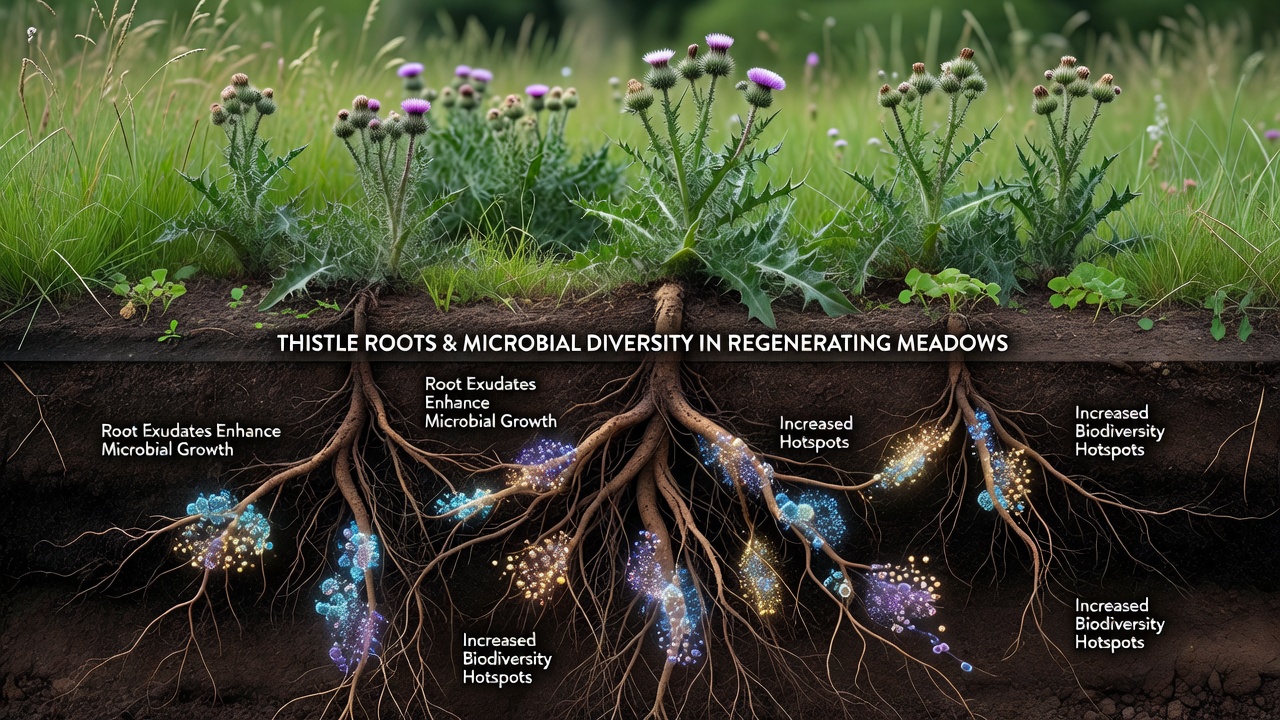
Thistle roots extend deep into meadow soils where they interact with bacterial and fungal communities that support ecosystem recovery after disturbance events such as grazing pressure or land clearing. These taproot systems create channels that improve water infiltration while releasing organic compounds that certain microbes metabolize as energy sources. Data from long-term field plots indicate that areas with established thistle populations show elevated counts of nitrogen-fixing bacteria and arbuscular mycorrhizal fungi compared with adjacent plots lacking similar root structures.
Root Architecture and Soil Microhabitats
Thistle species develop extensive lateral and vertical root networks that alter soil aggregation patterns and create microhabitats where microbial activity concentrates. Researchers have measured higher respiration rates near root tips because carbon exudates stimulate bacterial growth and subsequent fungal colonization. This process occurs consistently across multiple meadow types where thistles appear during early succession stages. Observers note that root diameter and branching density correlate with increases in microbial biomass carbon according to measurements taken at various soil depths.
Microbial Community Shifts During Meadow Recovery
Studies tracking microbial succession in regenerating meadows reveal that thistle roots coincide with shifts in bacterial phyla such as Proteobacteria and Actinobacteria that contribute to organic matter decomposition. Fungal diversity also rises when thistle roots penetrate compacted layers because hyphal networks extend into new pore spaces created by root growth. In September 2026 monitoring programs documented these patterns across several European and North American sites where meadow restoration projects included natural thistle colonization. The presence of specific root-associated microbes correlates with faster establishment of perennial grasses and forbs once initial disturbance subsides.
One research team documented elevated enzyme activity including dehydrogenase and phosphatase levels in soil samples collected adjacent to thistle roots whereas control samples from root-free zones showed lower values. These enzymes participate in nutrient cycling that benefits surrounding vegetation. Data collected over multiple growing seasons further indicate that microbial evenness improves when thistle density remains within moderate ranges rather than reaching dominance levels that might suppress other plant species.
Nutrient Cycling and Microbial Mediation
Thistle roots participate in phosphorus solubilization through associations with specific bacterial strains that produce organic acids capable of releasing bound phosphates from soil minerals. This contribution becomes noticeable in meadows where phosphorus availability limits plant regrowth after erosion or intensive agriculture. Australian research published through the Commonwealth Scientific and Industrial Research Organisation has examined similar dynamics in temperate grasslands where introduced and native thistle populations influence local nutrient profiles. The resulting microbial activity supports seedling recruitment of desirable meadow species that require improved nutrient access during establishment phases.
Carbon inputs from decaying thistle roots also sustain heterotrophic bacteria that break down complex polymers and release simpler compounds usable by other soil organisms. These sequential processes contribute to overall soil organic carbon accumulation which in turn stabilizes microbial populations against seasonal fluctuations in temperature and moisture. Field experiments demonstrate that removal of thistle roots through targeted management reduces subsequent microbial respiration rates within two growing seasons.
Evidence from Comparative Field Studies
Comparative analyses across disturbed meadows show consistent associations between thistle root presence and increased operational taxonomic units within soil metagenomes. Canadian government agricultural research stations have reported similar findings in prairie restoration trials where thistle roots coincided with greater bacterial alpha diversity indices. These patterns hold after controlling for variables such as soil pH and texture. The evidence suggests that thistle roots act as facilitators rather than primary drivers yet their role remains measurable in community assembly metrics.
Additional observations from long-term plots indicate that thistle-mediated microbial changes persist even after aboveground thistle biomass declines because residual root material continues to supply substrates. This legacy effect supports continued diversity in fungal communities that form symbiotic relationships with later-successional plants. Such dynamics appear across multiple geographic regions and meadow types where natural regeneration follows initial disturbance.
Conclusion
Thistle roots influence microbial diversity through physical modification of soil structure and chemical inputs that stimulate specific bacterial and fungal groups during meadow regeneration. Measurements from multiple studies confirm elevated microbial biomass and enzyme activity near these roots while comparative data link their presence to improved nutrient cycling parameters. Ongoing monitoring through 2026 continues to document these interactions across varied restoration contexts where thistle populations occur at moderate densities. The accumulated findings establish thistle roots as contributors to soil biological processes that support overall meadow recovery trajectories.