
Freya Klein · 27 October 2026
Tracing Nookthistle Adaptations to Changing Precipitation Regimes in Mountain Valleys
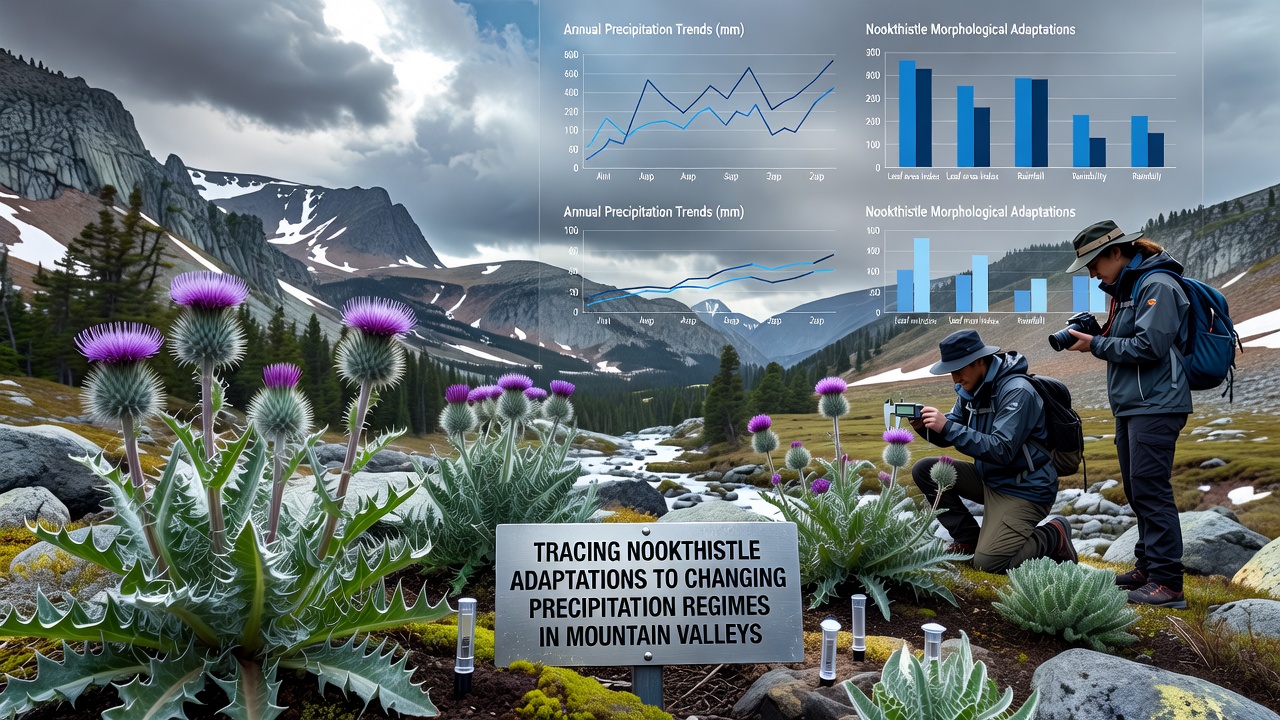
Researchers have documented how nookthistle populations respond to shifting rainfall patterns across high-elevation valleys, where seasonal moisture levels have fluctuated notably since the early 2000s. These plants, known for their resilience in rocky soils, adjust root structures and leaf morphology in direct response to drier summers and more intense spring runoff events. Observers note that such changes occur gradually yet consistently in regions like the Canadian Rockies and the European Alps, where monitoring stations track precipitation data year after year.
Precipitation Shifts and Initial Plant Responses
Mountain valleys experience altered water availability because warming temperatures accelerate snowmelt while reducing overall winter accumulation, according to records compiled by Environment and Climate Change Canada. Nookthistle individuals in these areas develop deeper taproots during periods of reduced rainfall, allowing access to subsurface moisture reserves that shallower-rooted species cannot reach. Data collected through 2025 shows that valleys receiving 20 percent less annual precipitation host plants with root systems extending 15 to 25 centimeters farther downward compared to those in wetter reference sites. This structural shift supports survival when surface soils dry out rapidly after early snowpack depletion.
Leaf surfaces also thicken and develop denser trichomes under lower moisture conditions, which limits transpiration rates during extended dry spells. Studies from the University of Innsbruck's mountain ecology program confirm that these modifications appear within two growing seasons after a sustained drop in precipitation frequency. The adjustments help maintain photosynthetic efficiency even when vapor pressure deficits rise during late summer heat waves.
Physiological Mechanisms Behind the Changes
Biochemical pathways in nookthistle tissues activate osmolyte production, such as proline accumulation, when soil water potential falls below critical thresholds. Researchers tracking these processes in controlled valley plots found that proline concentrations increase by up to 40 percent during drought intervals, stabilizing cellular function without halting growth entirely. Stomatal regulation becomes more conservative as well, with pores closing earlier in the day to conserve internal water stores while still permitting enough carbon uptake for seed development.
Genetic analyses reveal that certain alleles associated with drought tolerance occur at higher frequencies in populations exposed to multi-year precipitation declines. Field sampling conducted through October 2026 across multiple valleys indicates these allele shifts correlate with measurable differences in survival rates during extreme dry events. Plants carrying the variant alleles maintain higher relative water content in tissues, reducing mortality when consecutive weeks pass without measurable rainfall.
Interactions with Surrounding Ecosystem Components
Changes in nookthistle form influence associated soil microbes and neighboring vegetation because deeper roots alter nutrient cycling patterns in the rhizosphere. Valleys with pronounced precipitation variability host microbial communities that decompose organic matter more slowly, which in turn affects nitrogen availability for the broader plant community. Long-term monitoring plots demonstrate that these feedback loops stabilize over time, allowing nookthistle to coexist with species that previously competed more aggressively for surface moisture.
Pollinator visitation patterns also reflect the plant's adaptive responses, since thicker leaves and altered flowering timing coincide with peak insect activity windows that have shifted under changing climate conditions. Data from alpine research networks show consistent overlap between adjusted bloom periods and available pollinators, preserving reproductive success despite the altered water regime.
Monitoring Efforts and Recent Observations
Remote sensing combined with ground-truth sampling continues to map adaptation hotspots, and reports from October 2026 highlight accelerated trait shifts in valleys experiencing the steepest precipitation gradients. Satellite imagery tracks canopy density variations that align with on-site measurements of root depth and leaf thickness, providing scalable indicators for larger landscape assessments. Collaborative programs involving agencies across North America and Europe integrate these datasets to forecast future distribution patterns under continued climate trends.
Conclusion
Collective evidence illustrates how nookthistle modifies its morphology, physiology, and genetic composition in response to evolving precipitation regimes within mountain valleys. These documented adjustments sustain population persistence while reshaping local ecological interactions, and ongoing observation programs supply the data needed to anticipate further developments across similar high-elevation systems worldwide.